Collection: Sea Urchin

🌊

Sea Urchin Fossil — ancient oceans, fivefold design and an aura of steady adaptation

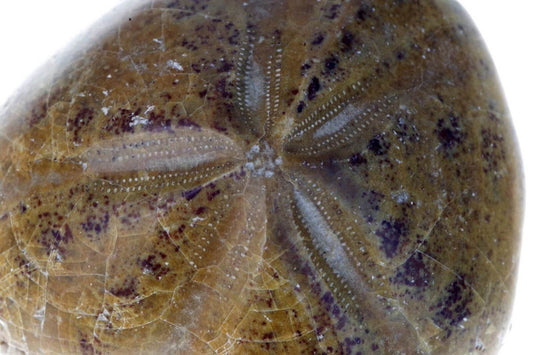
Sea Urchin fossils preserve the remains or impressions of echinoids—marine animals related to starfish and sand dollars. Their rigid skeleton, known as a test, was assembled from interlocking calcite plates arranged around a distinctive five-part plan, often leaving star-like pore rows, ridges and spine sockets visible in stone.

✨ What makes Sea Urchin fossils special?

  • Their stars once supported living tube feet: paired pores form five radiating ambulacra through which flexible tube feet extended during the animal’s life.
  • Their surface preserves missing armour: rounded tubercles mark the attachment points of movable spines that usually detached before or during fossilisation.
  • They can survive in several geological forms: specimens may retain calcite plates or occur as internal moulds, external impressions, mineral replacements and sediment-filled casts.

🔮 Sea Urchin Fossil aura

  • Aura of steady adaptation: a Sea Urchin fossil may represent preserving a reliable inner structure while responding thoughtfully to changing surroundings.
  • Aura of balanced boundaries: its vanished spines can serve as reminders that protection may remain firm without preventing movement or connection.
  • Aura of deep-time perspective: its ancient marine origin may symbolise viewing present difficulties as one chapter within a much larger unfolding story.

⭐ What else makes Sea Urchin fossils fascinating?

  • They appeared long before dinosaurs: echinoids have inhabited the seas since the Late Ordovician, roughly 450 million years ago.
  • Not every fossil resembles a round urchin: the group also includes heart-shaped forms, thick sea biscuits and flattened sand-dollar relatives.
  • Their star patterns entered folklore: fossil echinoids acquired regional names such as fairy loaves, shepherds’ crowns and thunderstones.

Keep a Sea Urchin fossil nearby when change calls for both flexibility and a dependable centre. Let its fivefold architecture remind you that adaptation does not require losing every familiar part—sometimes it means reorganising enduring strengths for a different sea.

Find the steady centre. Respect the changing tide. Let ancient structure support thoughtful adaptation.