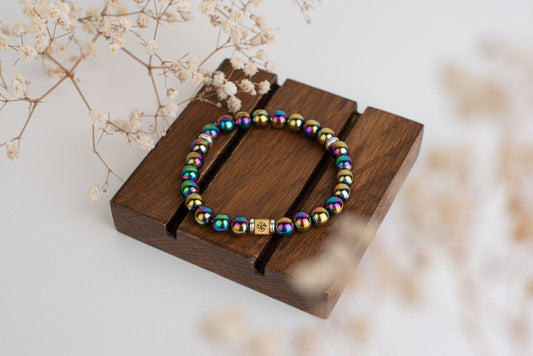
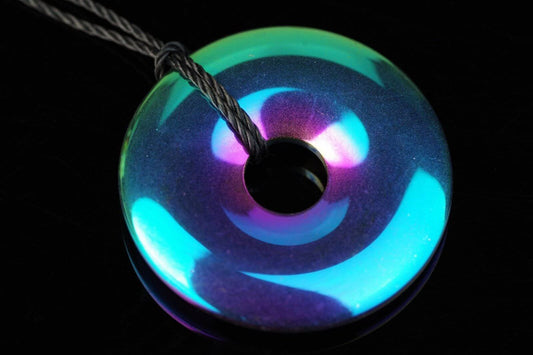
Collection: Rainbow hematite

🌈

Rainbow Hematite — metallic colour, nanoscale wonder and an aura of changing perspective

Rainbow Hematite is a descriptive name for naturally iridescent Hematite whose steel-grey surface reflects violet, blue, green, gold and copper tones. In well-studied specimens, these colours arise from light interacting with extremely thin nanocrystalline surface coatings rather than from coloured pigment within the Hematite itself. As the viewing angle changes, different wavelengths strengthen and the visible spectrum appears to move.

✨ What makes Rainbow Hematite special?

  • Colour created by structure: its rainbow display is an interference effect produced when light reflects from the upper and lower boundaries of an ultrathin surface layer.
  • A changing metallic landscape: one specimen may shift from violet and indigo to turquoise, green, gold and copper as the stone or light source moves.
  • Nanometres shaping what we see: tiny changes in the thickness and arrangement of the surface coating determine which colours become visible to the eye.

🔮 Rainbow Hematite aura

  • Aura of changing perspective: Rainbow Hematite may represent how one reality can reveal entirely different colours when approached from another angle.
  • Aura of grounded imagination: its dense iron-rich foundation beneath a radiant surface can symbolise creativity supported by practical structure and steady action.
  • Aura of integrated possibility: its many colours appearing upon one mineral may serve as a reminder that contrasting qualities can belong to the same complete identity.

💫 Iridescent lore and care

Rainbow Hematite is not a separate mineral species but an iridescent variety or appearance of Hematite. The name is also used commercially for coated, treated or manufactured materials, including strongly magnetic ferrite beads. Natural pieces may show uneven colour following crystal grains and surface texture, while identification should consider the substrate, streak, density, magnetism and reliable provenance rather than colour alone.

The Hematite beneath the colour measures approximately 5–6.5 on the Mohs scale, but the delicate iridescent surface may be much easier to scratch, dull or remove. Handle specimens by their edges and clean only with a soft dry brush or clean microfibre cloth. Avoid polishing compounds, abrasive rubbing, acids, solvents, soaking, steam and ultrasonic cleaning, as damage to the nanoscale coating may permanently reduce the rainbow effect.

Keep Rainbow Hematite nearby when one fixed interpretation no longer reveals the whole picture. Let its shifting metallic spectrum remind you that perspective does not always change the truth beneath the surface—it may simply uncover colours that were already waiting within the light.

Change the angle. Discover the colours already present.