Collection: Leopardite Jasper

🐆

Leopardite Jasper — volcanic rosettes, watchful patterns and an aura of perceptive confidence

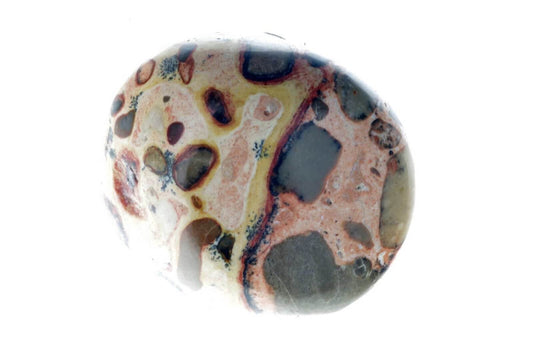
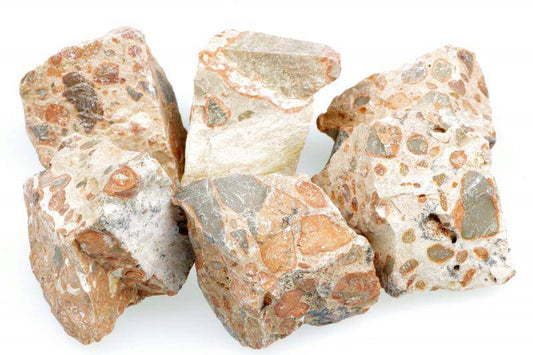
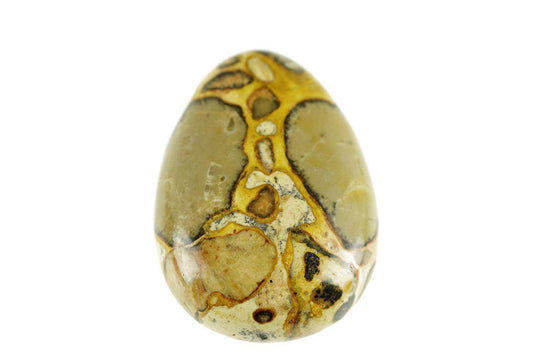
Leopardite Jasper, also called Leopard Skin Jasper or Leopard Skin Rhyolite, is a trade-named spotted volcanic rock rather than true Jasper. Its cream, salmon, ochre, grey and charcoal patterns commonly form within rhyolitic material containing Quartz, alkali feldspar, altered volcanic glass and mineral-rich halos. Cutting through its three-dimensional structures reveals circles, eyes, rosettes, crescents and flowing chains.

✨ What makes Leopardite Jasper special?

  • Volcanic glass became patterned crystal: microscopic Quartz and feldspar may grow outward from local centres as cooling glass gradually devitrifies into rounded spherulites.
  • Every spot changes with the cut: a central section reveals a broad circular rosette, while angled or off-centre cuts create smaller eyes, ovals, crescents and incomplete halos.
  • Several processes share one design: volcanic flow, alteration, oxide concentration, cavities, fractures and later silica infill may all contribute to the finished pattern.

🔮 Leopardite Jasper aura

  • Aura of pattern recognition: Leopardite may represent noticing repeated choices, signals and habits clearly enough to decide which ones should continue.
  • Aura of watchful confidence: its eye-like rosettes can serve as a reminder to observe patiently before acting, without allowing awareness to become constant suspicion.
  • Aura of protected individuality: each distinct spot remains part of one continuous rock, symbolising personal identity held securely within a larger relationship, team or purpose.

💫 Leopard-pattern lore and care

Leopardite is a commercial appearance name rather than a formal mineral species, and similar names may be applied to different spotted rocks. The dark rims can reflect oxides, altered minerals, grain-size changes or chemical boundaries, so they should not automatically be assigned to one specific mineral without analysis. The rosettes are geological structures, not fossilised animal markings or biological growth.

Sound Quartz–feldspar areas commonly measure approximately 6–7 on the Mohs scale, while altered, porous or clay-rich zones may be softer. Clean briefly with lukewarm water, mild soap and a soft cloth or brush, then dry around drill holes and fractures. Avoid prolonged soaking, sharp impacts, strong acids, bleach, solvents, steam and ultrasonic cleaning when dye, wax, resin, backing, coatings or repairs may be present.

Keep Leopardite Jasper nearby when recurring patterns need to be recognised without losing curiosity or confidence. Let its watchful volcanic eyes remind you that perspective can change the visible shape—and that careful observation often reveals where the next deliberate step should begin.

Notice the pattern. Protect the centre. Choose the next step deliberately.