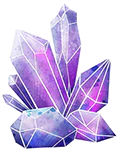

Sapphire — Blue, Yes, But Also the Whole Rainbow
Sapphire is corundum colored by trace elements and geology’s flair for drama. The name evokes deep blue—sea at midnight—but sapphire also comes in pink, yellow, green, purple, gray, near‑colorless, and the lotus‑tinged padparadscha. Some stones host a star that slides across a dome under a single light; others shift color from daylight to dinner. If gems threw soirées, sapphire would be the impeccably dressed guest who’s somehow at ease in every room.
Identity & Naming 🔎
Sapphire vs. ruby
Both are corundum (Al₂O₃). When chromium turns the stone red, we call it ruby. All other hues are sapphire: blue is the classic; the rest are “fancy sapphires.”
Where the colors come from
Blue: intervalence charge transfer between Fe²⁺ and Ti⁴⁺ gives that saturated cobalt‑to‑royal tone. Yellow/green: Fe³⁺. Pink/purple: Cr³⁺ ± Fe. Color change: V and Cr working together to shift daylight vs. incandescent balance. Padparadscha: a delicate pinkish‑orange blend—lotus‑flower inspired.
Where Sapphires Form 🧭
Metamorphic belts
In aluminum‑rich, silica‑poor rocks (gneiss, schist, marble), corundum crystallizes during regional metamorphism. These can yield lighter, “open” blues and fine fancy hues.
Basaltic terrains
Corundum crystals travel up with alkali basalts and weather into alluvial gravels. Basalt‑related sapphires commonly show iron‑rich, deeper or inky blues and teals.
After the mountain‑making
Because sapphire is tough, many deposits are placer: rivers concentrate durable corundum, zircon, and spinel into gemmy streaks—nature’s treasure traps.
Star setup
Upon slow cooling, tiny rutile exsolve along crystallographic directions, weaving three sets of needles 60° apart. Light reflects along these, giving a star when cabbed.
Zoning happens
Growth in pulses and shifting chemistry draw hexagonal color zones or “bullseyes.” Cutting orientation can either hide these or show them off as geometry.
Treatments you’ll meet
Gentle to high‑temperature heat treatment is common to clarify and balance color. Diffusion (esp. beryllium for orange/pink) can alter hue more dramatically; a minority are filled to heal fractures. Clear labeling keeps collections useful.
Recipe: aluminum‑rich source + pressure/heat or basaltic ride + time. The rest is trace‑element spice.
Colors & Pattern Vocabulary 🎨
Palette
- Cornflower / royal blue — the classic, from bright to deep.
- Teal / green‑blue — Fe‑rich or Montana flavors.
- Yellow — sunny to gold.
- Pink / purple — Cr‑tinted romance.
- Padparadscha — tender pinkish‑orange “lotus.”
- Grey / near‑colorless — subtle, modern tones.
Blue sapphires often show pleochroism (blue ↔ slightly greenish‑blue or violet‑blue) depending on orientation and light.
Pattern words
- Silk — clouds of fine rutile needles; can soften color to a velvety glow.
- Hex zoning — concentric hexagons or sector bars of color.
- Asterism — six (sometimes 12) rays on a dome; sharpest with abundant, oriented silk.
- Color‑change — blue‑green by day, purple by night (varies with chemistry).
Photo tip: For blue, use a neutral light and a dark card underneath; for stars, a single point light above the dome makes the rays snap into place.
Physical & Optical Properties 🧪
| Property | Typical Range / Note |
|---|---|
| Chemistry | Al₂O₃ (corundum) with trace Fe, Ti, Cr, V, etc. |
| System / Habit | Trigonal; hexagonal prisms and bipyramids; tabular crystals |
| Hardness | 9 (second only to diamond in common gems) |
| Specific gravity | ~3.95–4.05 |
| Refractive index | ~1.762–1.770; birefringence ~0.008–0.010; uniaxial (−) |
| Cleavage / Parting | No true cleavage; rhombohedral parting can occur |
| Pleochroism | Distinct in many colors (notably blue); best seen with a dichroscope |
| Fluorescence | Pink/orange can glow (Cr); many blue Fe‑rich stones are weak/inert |
| Phenomena | Asterism (star), color‑change, occasionally sheen |
| Common enhancements | Heat; beryllium or surface diffusion (color); occasional fracture filling |
Under the Loupe 🔬
Silk & stars
Fine, parallel rutile needles in three directions at 60° can make asterism. In faceted stones, faint silk adds a soft “sleepy” texture that can be beautiful.
Classic inclusions
Zircon crystals with stress halos, hexagonal growth lines, fingerprint heals, and negative crystals are all friendly signs of nature’s hand.
What hints at lab or heavy diffusion
Flame‑fusion synthetics show curved growth lines and gas bubbles; surface or lattice diffusion can show strong color along facet junctions and at the surface with paler cores. Magnification tells great stories.
Look‑Alikes & How to Tell 🕵️
Blue spinel
Lower RI (~1.718), singly refractive (no pleochroism), often slightly softer look. A dichroscope quickly separates it from pleochroic sapphire.
Iolite (cordierite)
Strong pleochroism (blue‑violet ↔ pale/yellowish) but softer (Mohs ~7–7.5) and more brittle; different crystal system and inclusions.
Blue topaz / tanzanite
Topaz has perfect basal cleavage and RI ~1.61–1.62; tanzanite shows trichroism (blue‑violet‑burgundy) and is softer. Neither hits sapphire’s hardness 9.
Glass & doublets
Glass has low RI, bubbles, and no pleochroism. Doublets show join lines under magnification—look around the girdle.
Kyanite & blue zircon
Kyanite shows two very different hardnesses and perfect cleavage; zircon has high birefringence (facet “doubling”) and is denser.
Quick checklist
- Hardness 9 (resists scratches from quartz/steel).
- Pleochroism present? Good sign for sapphire.
- No curved striae; inclusions feel “geologic,” not bubbly.
Localities & Flavor Notes 📍
Blue icons
- Kashmir (historic) — velvety “cornflower” blues from abundant fine silk.
- Sri Lanka (Ceylon) — lively medium blues and a full rainbow of fancy colors.
- Myanmar (Mogok) — rich royal to inky blues, fine pinks too.
- Madagascar — major modern supply; wide palette including pad‑like pastel blends.
Distinctive characters
- Australia — deep, sometimes inky blues (Fe‑rich basaltic lineage).
- Montana, USA — bright teals, greens, and Yogo’s famously clean medium blues.
- East Africa (Tanzania/Kenya) — Umba/Tunduru produce yellow, pink, and color‑change surprises.
- Cambodia/Thailand — classic blues; Chanthaburi also a major cutting/treatment hub.
Care & Lapidary Notes 🧼💎
Everyday care
- Clean with lukewarm water + mild soap + soft brush; rinse & dry.
- Ultrasonic/steam: generally fine for unfilled, heat‑treated stones; avoid on filled or heavily included pieces.
- Hardness 9 ≠ invincible—sharp blows can exploit parting. Treat like a fine lens.
Jewelry tips
- Blue shows best in well‑proportioned cuts that avoid “windows.”
- For stars, cut a high dome with the c‑axis centered so the star sits dead‑center.
- Fancy colors (yellow, pink) shine in warm metals; blues love contrast with white metals.
On the wheel
- Orient to manage pleochroism—aim for the richer axis face‑up.
- Pre‑polish through 3k–8k → finish with alumina or diamond on a firm pad.
- Mind parting planes when sawing; a tiny tilt can save a big chip.
Hands‑On Demos 🔍
Pleochroism peek
Hold a blue sapphire and rotate under neutral light. With a simple dichroscope (or polarized sunglasses), you’ll see two shades—often blue and slightly greenish‑blue/violet‑blue—trading places.
Star test
Shine a single penlight above a star cabochon. A six‑rayed star should glide smoothly. If it splits or wanders, the dome may be off‑axis—or you’ve discovered a quirky double‑star!
Light joke: sapphire is proof that “feeling blue” can be a very good thing.
Questions ❓
Is sapphire always blue?
No—blue is the classic, but fancy sapphires span pink, yellow, green, purple, gray, near‑colorless, and the pinkish‑orange padparadscha.
What makes padparadscha special?
Its delicate balance of pink and orange. The exact boundary is debated in trade circles; the spirit is “lotus flower at sunset.”
Natural or synthetic—how do I tell?
Magnification helps. Curved striae and gas bubbles suggest flame‑fusion lab sapphire; natural stones show mineral inclusions, angular zoning, or silk. Lab sapphires are still corundum—just grown by humans.
What causes color change?
Trace elements (often V + Cr) tune how the stone absorbs different parts of the spectrum. Daylight skews blue; incandescent light leans red—your gem plays along.
Will sapphire scratch diamond?
No—diamond is harder. But sapphire (9) will happily scratch most everyday materials, so store it separately to keep neighbors happy.