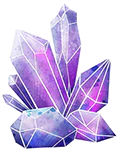

Quartz — The Everywhere Gem That Still Manages to Surprise
Quartz is Earth’s extrovert mineral: abundant, adaptable, and always ready for a good sparkle. It grows clear “rock crystal” prisms, violet amethyst, smoky browns, sunny citrine, blush rose quartz, and the entire microcrystalline world of agate and jasper. It rings in at Mohs 7, takes a beautiful polish, and—thanks to its piezoelectricity—keeps time in your wristwatch. If minerals had résumés, quartz’s would just say “does everything well” and attach a thousand photos.
Identity & Family Tree 🔎
Macro vs. micro (chalcedony)
Macrocrystalline quartz forms visible crystals: rock crystal, amethyst, citrine, smoky, rose, milky. Micro/cryptocrystalline quartz is chalcedony—fibrous micro‑quartz + moganite—responsible for agate (banded), jasper (opaque), chert/flint, carnelian, chrysoprase, and more.
Polymorph cousins
Same chemistry, different structures: high‑temperature tridymite and cristobalite; high‑pressure coesite and stishovite. Quartz is the low‑pressure champion at Earth’s surface.
Where Quartz Grows 🧭
Hydrothermal veins & geodes
Silica‑rich fluids cool in cracks and cavities, lining them with prismatic crystals. In volcanic terrains, gas bubbles become geodes—amethyst cathedrals and sparkling druses included.
Pegmatites
Granitic late‑stage melts grow large crystals with room to stretch. Quartz is the faithful backdrop to feldspar, tourmaline, beryl, and friends.
Sedimentary & metamorphic
Quartz cement binds sandstones; pressure cooks sand into quartzite in metamorphism. Microcrystalline quartz replaces fossils and wood in exquisite detail.
Colors by physics & chemistry
Amethyst (Fe color centers + radiation); smoky (Al centers + irradiation); citrine (heated amethyst or Fe centers); rose (microscopic fibrous inclusions—often dumortierite‑like); milky (fluid inclusions).
Inclusions worth knowing
Rutilated quartz (gold needles), tourmalinated quartz (black tourmaline), chlorite “gardens”, phantoms (faint growth outlines), and rare enhydros (fluid bubbles).
Artificial but awesome
Hydrothermal lab‑grown quartz is produced for optics and electronics—chemically identical, grown on seed plates, and impeccably clear.
Short version: if water can carry dissolved silica there, quartz can move in and decorate the space.
Colors & Pattern Vocabulary 🎨
Palette
- Rock crystal — colorless, transparent.
- Amethyst — lilac to royal violet.
- Citrine — pale lemon to honey.
- Smoky — tea to near‑black (“morion”).
- Rose — soft pink, often milky.
- Milky — opalescent white from micro‑bubbles.
Chalcedony adds banded agate, opaque jasper, carnelian oranges, apple‑green chrysoprase, and more.
Habit words
- Prismatic hexagonal crystals ending in pyramids; common Dauphiné & Brazil twinning.
- Japan‑law twins — two crystals in a V at ~84.6° (collector favorites).
- Drusy coatings of tiny crystals; scepters (a late crown over an earlier stalk); skeletal and window growth in fast‑cool cavities.
Photo tip: Back‑light thin edges to make color hum; side‑light ~30° for faces and striations. A black card behind clear crystal produces crisp silhouettes.
Physical & Optical Properties 🧪
| Property | Typical Range / Note |
|---|---|
| Chemistry | SiO₂ (silicon dioxide) |
| System | Trigonal (α‑quartz at ambient conditions) |
| Hardness | ~7 Mohs (scratches glass; resists everyday wear) |
| Specific gravity | ~2.65 |
| Cleavage / Fracture | No true cleavage; conchoidal fracture with shell‑like curves |
| Refractive index | ~1.544–1.553; birefringence ~0.009; uniaxial (+) |
| Optical effects | “Rainbows” from healed micro‑fractures; aventurescence in aventurine (fuchsite/goethite platelets) |
| Electric | Piezoelectric (mechanical stress ↔ electric charge), cornerstone of oscillators |
Under the Loupe / Collector Clues 🔬
Faces & striations
Primary prism faces show faint horizontal striations. Termination symmetry can reveal left/right‑handed crystals; twins may show repeated, mirror‑like growth steps.
Color zoning & phantoms
Amethyst often displays zoned color toward terminations; phantoms (ghostly outlines) mark pauses in growth—each a time stamp in crystal biography.
Inclusion stories
Rutile needles cross like golden straw (rutilated quartz); black tourmaline rods (schorl) make bold graphics; chlorite gardens tint green; tiny fluid inclusions shimmer with movement when warmed.
Look‑Alikes & How to Tell 🕵️
Glass
Amorphous, lacks crystal faces; bubbles may be spherical and evenly sized; RI ~1.50 (lower). Quartz shows natural faces/striations and higher hardness (7 vs. ~5.5).
Calcite
Softer (3), shows perfect cleavage and strong double refraction; reacts with acid. Quartz has no cleavage and does not fizz.
Feldspar & topaz
Feldspar has two cleavages at ~90°, often cloudy; topaz is harder (8) with basal cleavage. Cleavage is the quick tell—quartz doesn’t have it.
Dyed agate vs. natural
Neon, uniform color in banded chalcedony suggests dye; natural agate shows subtle, uneven band tones and gradual transitions.
Synthetic quartz
Hydrothermal growth can be ultra‑clean with chevron zoning and seed‑plate evidence; natural stones often include micro‑bubbles, mineral inclusions, or uneven zoning.
Quick checklist
- Hardness 7; no cleavage; vitreous luster.
- Crystal faces/striations in macro types.
- Banding & translucency in agate; opacity in jasper.
Localities & Famous Forms 📍
Crystal classics
Brazil (Minas Gerais) — large, fine crystals and amethyst; Arkansas, USA — water‑clear clusters; Alpine region — smoky quartz & gwindels (twisted crystals); Herkimer County, NY — “Herkimer diamonds” (doubly terminated in dolostone).
Chalcedony world
Uruguay & Brazil — amethyst geodes; Madagascar — banded agates and jaspers; Pacific Northwest, USA — celebrated picture jaspers; Worldwide — agate nodules & fortification patterns galore.
Care & Display 🧼
Everyday handling
- Quartz is tough, but sharp impacts can chip tips/edges.
- Store separately from softer stones (quartz wins most scratch fights).
- Avoid sudden thermal shock (very hot → very cold).
Cleaning
- Lukewarm water + mild soap + soft brush; rinse well, dry with microfiber.
- Skip bleach and strong acids; they don’t help and may attack inclusions/matrix.
- Ultrasonic: usually fine for clean crystals, but avoid for included/filled stones.
Display ideas
- Back‑light geode slices to make bands glow; side‑light points for face sparkle.
- Pair a clear crystal with a rutilated and a banded agate—one species, three personalities.
Hands‑On Demos 🔍
Hardness reality check
On a spare glass tile, a quartz edge will leave a line (hardness 7). Do not use your window—quartz is enthusiastic about proving its point.
Phantom hunt
Rock crystal under a bright point light often reveals phantom outlines. Tilt slowly and look for faint triangular pyramids inside the main termination.
Small joke: quartz is the friend who shows up to help you move, keeps perfect time, and brings a sparkle. Reliable and fabulous.
Questions ❓
Is all citrine natural?
Not always. Much on the market is heat‑treated amethyst (deeper orange, often with white bases). Natural citrine tends to be paler and more uniform.
Why is some rose quartz cloudy?
Microscopic fibrous inclusions scatter light, giving a soft, milky look. Facetable “transparent” rose quartz is less common.
What’s the difference between quartz and quartzite?
Quartz is a mineral. Quartzite is a metamorphic rock of fused quartz grains. Quartzite scratches steel easily and shows sugary granular texture on breaks.
Are “Herkimer diamonds” diamonds?
No—just wonderfully clear, doubly terminated quartz crystals from dolostone pockets. They sparkle like they’re auditioning, hence the nickname.
Why do some clear crystals show little rainbows?
Tiny internal fractures or fluid films act like prisms, splitting light into interference rainbows when the angle is just right.